[ad_1]
After over a decade of practising Pilates, there’s one thing I’ve learned about the method above all else: consistency is key. When it comes to really noticing those strength gains, you have to stay on track – and it can be difficult to notice progress until you start to advance a move.
There are very few (if any) Pilates moves I haven’t tried – but this isn’t to say that I’m an expert at any of them. I’m humbled pretty much every time I take to the mat or reformer – and I wouldn’t have it any other way.
This being said, there’s one move I’ve been actively avoiding: boat pose. Aside from being a fairly advanced move, it also taps into all my weak spots: tight hip flexors, lower back and core. But having researched the position, it’s clear that I need to buckle up: there are some serious benefits to be gained.
Rumoured to be as effective at strengthening the core as 100 sit-ups (the jury is out on this one, but hear us out!), the pose is in fact a Pilates/yoga hybrid – and it’s dividing the experts. Traditionalists insist that a boat pose is, in fact, simply a Pilates teaser, while others maintain there are subtle differences between the moves.
More on the controversy below, but my interest was piqued enough to spur me to try boat pose every day for two weeks, regardless. Keep scrolling to find out what happened to my core strength, stability and hip flexors – but in the meantime, you might want to check out our guides to the benefits of Pilates leg circles, the best Pilates exercises of all time, and the only Pilates clothes worth your money, here. Plus, find out how one Health Writer got on when she quit expensive studio classes for Pilates with Izzy for a year.
I Caved and Tried the Pilates Boat Pose—and, Wow
What is Pilates boat pose?
Let’s get into it: boat pose is both a yoga and a Pilates move – but its Pilates form is very similar to a teaser.
“Boat pose isn’t actually what we call this exercise in Pilates,” notes Pilates instructor Aleksandra Warburton. “The V-shaped position you’ll often see referred to as boat pose in yoga is very similar to the Pilates teaser, which is one of the more challenging exercises in the classical Pilates repertoire.
“The teaser involves balancing on the sit bones with the legs lifted, and the torso angled back, creating that recognisable V shape. It looks deceptively simple, but it requires a huge amount of core strength, balance, control and body awareness to perform well.”
This being said, there’s a school of thought that boat pose involves a slightly different spine position: in teaser, you may have a slight ‘C’ curve to the back, whereas boat pose requires a straight (or neutral) spine. Either way, the move is an advanced one, requiring deep core strength and stability alongside hip flexor strength and balance.
“It’s also worth making the distinction between boat pose in yoga and teaser in Pilates,” Warburton continues. “They can look remarkably similar, but they come from different movement traditions. In yoga, boat pose, or Navasana, is generally performed with a more upright, neutral spine, whereas the classical Pilates teaser incorporates a more rounded, articulated spine as you roll up and down. Most importantly, Teaser is not simply about holding a V shape; the rolling movement into and out of the position is an important part of the exercise.”
What are the benefits of Pilates boat pose?
Whether you’re a yoga or a Pilates advocate, there’s no denying that boat pose brings substantial benefits once you’re ready for the move.
1. Core strength
First up, the biggest benefit of boat pose (and its biggest challenge) has to be core strength.
“This move is a fantastic full-body strength and control exercise, but the core is definitely the star of the show with this one,” notes Warburton. “It challenges the deep abdominals, including the TVA, as well as the obliques and rectus abdominis, while also requiring significant hip flexor and leg strength.”
2. Balance and co-ordination
Boat pose calls for both balance and co-ordination, forcing those deep core stabilising muscles to switch on.
“It’s also brilliant for balance, coordination and proprioception,” Warburton continues. “This is your understanding of your body in space: because you’re essentially asking your body to maintain a very challenging position while moving both the upper and lower body simultaneously, your proprioception will increase as you practice the move.”
3. Body awareness
As well as proprioception, boat pose enhances overall body awareness too.
“For me, one of the biggest benefits is the body awareness the move develops,” shares Warburton. “You have to understand where your pelvis, spine, legs and arms are positioned and coordinate them all together, which is what makes Teaser such a wonderful progression exercise.”
4. Overall stability and control
Since boat pose involves a lift and lower with control, you’re going to need to harness all the stability you can to avoid losing your form.
“This move requires balance, stability, control and full-body integration,” notes Pilates instructor and founder of Sol Studio, Meg Bew. ” Coordination, balance and control are essential – we want the movement to feel fluid and controlled, rather than something you have to throw yourself into.”
@blackyogaroom Movement Monday✨ Join me for a core challenge! Navasana, also known as Boat Pose, requires strength in the abdominals, hip flexors, and back muscles. It also engages the legs, shoulders, and arms, while demanding focus and motivation. Let’s try it together.
How to do Pilates boat pose with good form
As a more advance move, a focus on form is even more important than usual. Warburton recommends the following:
- Start lying on your back with your legs extended and arms reaching up.
- Engage your powerhouse, lift the head to look towards your toes and slowly begin to roll up through the spine, lifting the torso and legs together until you arrive in your V-shaped position.
- The aim is to balance on the sit bones whilst continuously reaching the chest up, rather than collapsing into the lower back.
- Keep the chest open, shoulders back and down away from your ears and arms reaching forwards on the outside of your thighs, with the legs long and together (ideally in a small turn out, which we call your Pilates V, meaning heels together, toes slightly apart to keep the inner thighs switched on and active).
- Most importantly, move slowly. I like to pause at the top and really own the V shape before lowering back down with control, keeping the toes in line with your eye line.
- The descent is just as important as the lift. If you can control the way back down rather than simply dropping to the mat, you’re getting a huge amount of strength work through the core.
Who is boat pose best for?
Despite being an advanced move, boat pose is suitable for most people.
“The move can be modified to accommodate different abilities, mobility restrictions and training goals,” shares Bew. “However, the full movement is best suited to more advanced Pilates practitioners, once the necessary strength, mobility and control have been developed.”
That being said, Bew warns that some people should avoid the move.
“Teaser places significant load through the lumbar spine and deep abdominal wall, so it isn’t appropriate for everyone. Caution (and in some cases avoidance) is advised for:
- Anyone with acute low back pain or an unresolved disc injury;
- Diastasis recti or postnatal clients who haven’t yet rebuilt deep core control, particularly in the early postnatal period;
- Those with reduced hamstring or hip flexor mobility that prevents the pelvis from stabilising correctly;
- Clients with cervical spine issues, given the loaded neck flexion involved
- Anyone with osteoporosis or reduced bone density, due to the spinal flexion under load;
- Pelvic floor dysfunction, where increased intra-abdominal pressure may be contraindicated.”
I tried a Pilates boat pose every day for two weeks – here are my honest thoughts
Week one
No stranger to a Pilates challenge, I’m excited for the fortnight ahead as I roll out my mat in week one. And – I won’t lie – I’m fairly confident that I’ll be able to nail the move by the time my two weeks are up.
It seems my years of Pilates have taught me very little, though – because there’s nothing simple about this move. I have to spend the first few days really focusing on engaging my core rather than my hip flexors, which seem to love really taking over – a sure-fire sign I’m not activating properly through my abs and obliques.
“The biggest thing to watch is trying to force the shape rather than earning it through strength and control,” notes Warburton. “If you’re gripping through the hip flexors, rounding excessively through the spine or throwing yourself into the V position using momentum, you’re probably not quite ready for the full exercise.”
Eek: consider myself humbled. My excuse? There are so many things to focus on at the same time with boat pose – and just when you think you’ve cracked one aspect, it turns out you’ve let all the others slide.
Another pitfall? Trying to go too high with the legs. Form trumps aesthetics, always.
“I’d also avoid sacrificing your form just to get your legs higher,” advises Warburton. “A slightly lower V with a beautifully controlled spine is far more valuable than forcing yourself into a perfect-looking shape.”
However, I’m no quitter, and I’m adamant that I am strong enough to master the move, with a bit of mind-muscle connection.

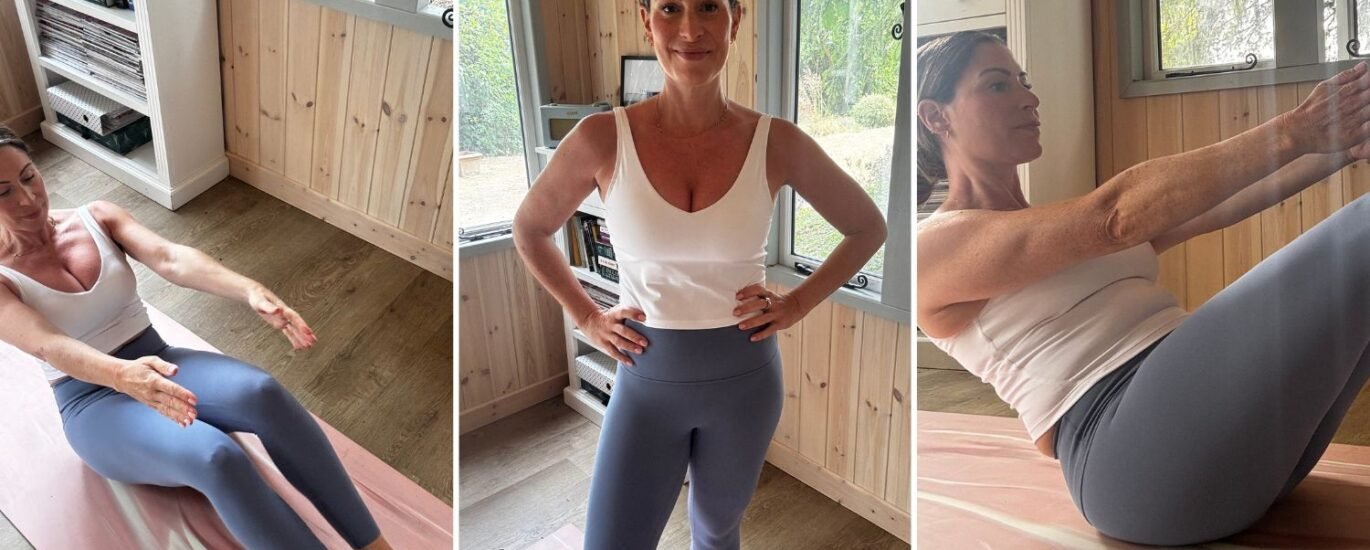
Health freelancer Anna Bartter during her two week long Pilates Boat Pose challenge. She found the move challenging, at first, but noticed strength improvements in just fourteen days.
(Image credit: Anna Bartter)
Week two
Undeterred, my mood is high at the start of week two – and, thankfully, the temperature has also dropped, so I’m not quite so hot and bothered: a win.
This being said, the move doesn’t feel altogether easier this week. I’m still quite shaky, and those hip flexors are bothering me again. However, Warburton is reassuring, telling me that if it feels easy, I’m probably not doing it properly.
Additionally, my body might need a break from the movement pattern, too.
“You don’t need to practice the move every day to benefit from it,” says Warburton. “For most people, incorporating it into a Pilates session two to three times a week is more than enough, particularly because it’s a relatively demanding exercise.”
Can I feel the difference? Without a doubt: my core is sore, and I’m still shaking my way through the reps (which, I’ll confess, I keep low!), but I’ve definitely noticed that I can hold the V shape a little longer without compromising my form – a small win, but one I’m taking, nonetheless.
The biggest flex, though, has to be how it makes me feel mentally to have stuck at it and not given up – full disclosure, I hate not feeling good at things – and it’s absolutely this that is the best takeaway.
Honestly? I’m not desperate to continue doing boat pose every day as the fortnight draws to a close. It’s a move I’ll definitely return to when I need a challenge, but it’s not going to be part of my daily routine any time soon.
Shop MC UK’s go-to Pilates kit now:

The Gym People Medium Support Longline Sport Bra
The exact top I wore for much of this challenge, and proof that decent workout kit needn’t cost a fortune. Gently supportive and super soft, it’s earned its place in my gym wear rotation.

Also tried and tested, this lululemon yoga mat is a firm favourite. Padded but grippy enough to support any pose, it’s totally worth the spend.

Varley Freesoft High Waisted Legging
If you’re in the market for some new gym leggings, you can’t go wrong with the Varley Freesoft range. Plus, the print is practically a neutral, right?
Can boat pose be advanced or modified?
“Absolutely,” shares Warburton. “One of my favourite ways to introduce the move is using props for additional support. A Pilates band or the Magic Circle can provide some feedback and assistance, while practising on the Reformer can make the movement more accessible because the straps and springs provide feedback as you lift into the V position.
“Once you’ve mastered the basic pose, you can progress it by adding the swinging arm movements, the lowering and lifting of the legs, introducing circles or progressing towards more dynamic variations, which means more reps and faster transitions. As a general rule of thumb, I tend to recommend lighter springs on the reformer(less reliance on feedback and more control just using your body) and more time under tension on the mat for an advanced variation.”
[ad_2]
Source link